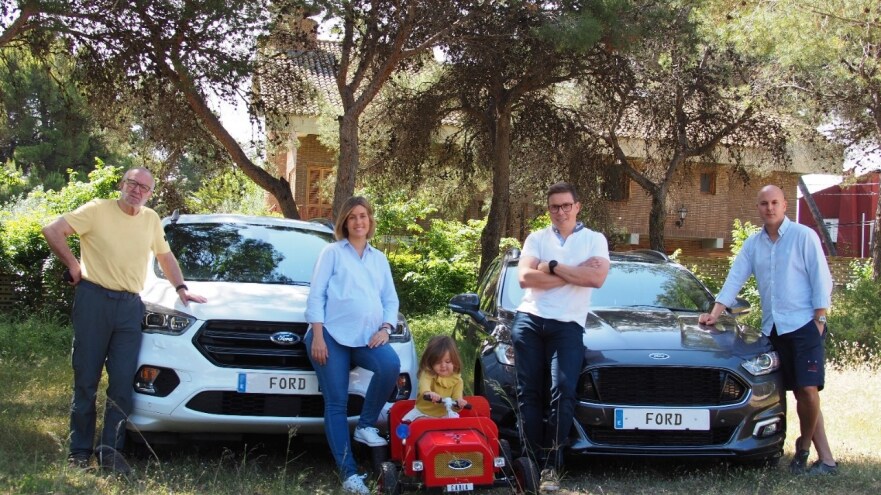
Carla Fernández de Liger might only be two years old, but if family tradition is anything to go by then a future in engineering awaits.
Mum Nerea Fernández de Liger and her husband Carlos are both trained engineers who met at the Ford assembly plant in Valencia, Spain, where they still work. So too, were Nerea’s father José and her mother Maria – one of the first female engineers to work on the assembly line there.
Nerea’s mother sadly passed in 2020. But she was an inspiration to her daughter – showing that gender need not be an obstacle when it came to choosing a career that has led her to become a supervisor in Material, Planning and Logistics, where her mother also worked.
Every year, Ford’s production facilities in Germany, Spain and the UK run numerous programmes to encourage girls to seek careers in engineering and technology. Even during times of travel and contact restrictions, these programmes have continued to run online.
Today, on International Women in Engineering Day, Ford is celebrating those who have followed in their family’s footsteps as well as highlighting the work that the company is doing to bring girls into engineering through those dedicated programmes.
“When I started studying engineering at the Ford Learning Center, my father always dropped me off and picked me up, as it was close to his workplace. I was so embarrassed at the time, but now I feel so proud remembering it,” said Nerea, who is a shipping and receiving supervisor for Ford of Europe. “Of all my Ford memories, being at the retirement parties for my parents is the best, seeing how our big Ford family gave them such a warm farewell.”
All in the family
Nerea is one among a number of female Ford engineers who have now picked up the baton to offer inspiration to the next generation of women. Here are just a few more of Ford’s women engineers who were inspired by their parents:
Alexandra Walker, powertrain quality manager, the UK
“My grandfather worked at the Ford plant in Leamington Spa in the 1940s and my father was a lecturer in engineering who taught many apprentices from Ford. I started as a vacation trainee at the Ford chassis and axle plant in Swansea 33 years ago and I’ve long been involved in initiatives to bring girls into engineering.”
Daniela Arts, manufacturing engineer, Germany
“I visited the Ford plant often as a child, and my father was excited to show me the production areas and cars. Working at Ford was the one thing I wanted and it was the only job application I wrote. This was for the do2technik dual study programme that includes an apprenticeship at Ford, a bachelor’s degree, work experience and a potential job at Ford, which I got.”
Kathrin Ruegenberg, body engineer, Germany
“I remember enjoying many family events at Ford with my father. He also actively helped me with science and technology subjects. When I was looking for an internship, my father encouraged me to do this at Ford, as I would come into contact with many different professions. I quickly set my sights on engineering and the do2technik programme got me on that path.”
Laura Florentin Dobreanu, product quality engineer, Romania
“Both of my parents were engineers, with my father working at the Oltcit plant in Craiova, which later became the Ford plant. It was a natural step for me and my brother to follow our parents into engineering, with both of us showing more affinity for science and mathematics than other subjects at school. I now work in the quality department, just as my father did.”
Laura Tudela Oltra, higher engineering apprentice, Spain
“My father started at Ford when he was 20 and had a workshop at our home. As he worked the nightshift, the two of us often spent the afternoons together, fixing bikes and tinkering with machines. I currently work in camshaft machining and am studying Industrial Electronics and Automation Engineering with the goal to work as an engineer at Ford.”
Mihaela Dana Toma, process engineer, Romania
“As a child, I set about repairing things in the home, which included putting in a new gasket to fix a leaking drain. I even took my mother’s iron apart and put it together again piece by piece to learn how it worked. I then stepped up to become my father’s sidekick when repairing cars and later followed him into engineering to work at the Ford plant in Craiova.”
Molly Starkes, higher engineering apprentice, the UK
“Ford in the UK runs many initiatives that include high school girls visiting the production plants. I participated in one of those days as a teenager, and this, along with my father having worked at Ford, inspired me to seek an engineering career at Ford, where I started when I was 16. I’m currently working towards an engineering degree at the University of Warwick.”
Bringing girls into engineering
Ford encourages female engineers from all walks of life, whether they have any previous connection with the company or not.
“Raising awareness of the exciting roles that exist in automotive engineering is really important to increase the ratio of female engineers and the diversity within Ford. Providing aspirational roles models to celebrate International Women in Engineering Day also contributes to ensuring we are seen as an employer of choice for women,” said Sarah Haslem, Women of Ford Board Member, Ford of Europe.
In Germany, a Girls’ Day is run every April, and was this year completed as an online event with schoolgirls aged 13 upwards. This is part of Frauen in Technik (Women in Technology) initiatives that also include summer and autumn holiday internships for girls, places available for girls to gain practical engineering experience, the Do2 programme that organises mentorships for girls ahead of starting an apprenticeship, and job orientation events at schools in the region.
The Ford production and engine plants in Craiova, in Romania, boast a gender balance of close to 50 per cent. Ford of Spain, meanwhile, is currently preparing to participate in a technology and innovation challenge that promotes engineering to girls.
In the UK, Ford women engineers have led the Women in Engineering Day since 2015, inviting more than 100 girls from local schools to participate in site tours, hands on engineering activities and panel discussions. Other initiatives include the Primary Engineer programme in schools and university student mentoring programmes.
“It’s not just about encouraging girls to choose engineering. It’s also about empowering our women engineers to celebrate their achievements and appreciating all that we bring to automotive engineering and manufacturing, such as different perspectives and an enhanced sense of collaboration,” said Friederike Philipsenburg, Ford of Europe’s Women in Engineering Panel, (whose father also worked at Ford).