LOMMEL, Belgium, June 17, 2014 – Few products these days can be expected not to miss a beat after 10 years of gruelling usage – especially if they are subjected to an extremely punishing working life, day in, day out.
Ford ensured the all-new Transit 2-tonne van will still be going strong by implementing a process of accelerated ageing that in just six months simulated the toughest treatment that customers can dish out in a decade.
Durability tests included the equivalent of driving 11 million kilometres – or 275 round-the-world trips – at state-of-the-art proving grounds and in extreme conditions across the globe where temperatures ranged from 40 C to -40 C.
“I don’t think many customers would believe what this vehicle has been through,” said David Gregory, Transit chief programme engineer, Ford of Europe. “We inflict the worst possible treatment that a van could endure, and we’re only satisfied when our new vehicle comes through with flying colours – just as the Transit has done.”
As the first Transit to be sold in both Europe and North America, the all-new model was subjected to accelerated durability testing both at Ford’s facilities in Lommel, Belgium, and in Romeo, Michigan.
At Lommel, Ford subjected the all-new Transit – including van, chassis cab and minibus versions – to more than 30 punishing vehicle tests. These included the trailer tow general durability test, conducted at maximum weight with a fully loaded trailer.
Further extreme challenges included being driven at top speed non-stop for two months, pounding over rough gravel roads, and through salt- and mud-baths. The prototypes also were tested for corrosion resistance in high-humidity chambers for 12 weeks and put through non-stop figures-of-eight for one month.
Engineers have driven the all-new Transit more than 5,000 times over an extreme course of potholes and bumps, and conducted a strength test by driving it at 60 km/h (37 mph) into a 140 millimetre kerb.
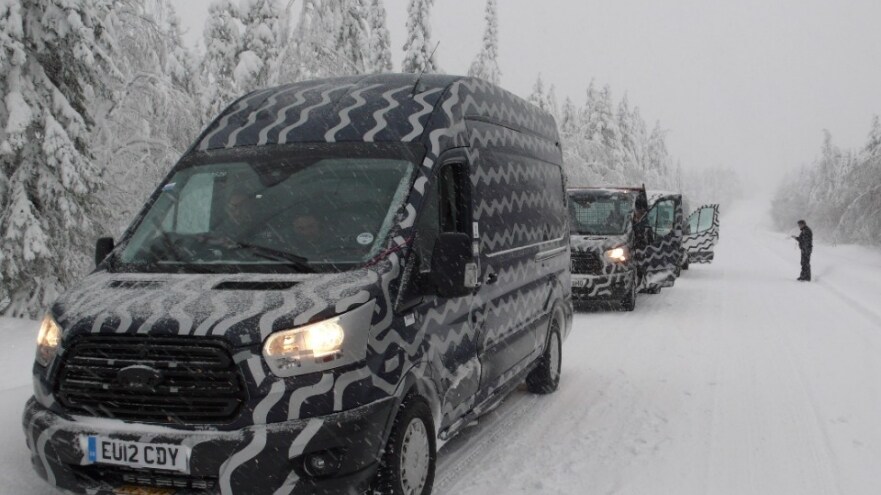
Ford also tested the Transit prototypes at carefully chosen locations in Europe, North America, Africa and Asia. Vehicles faced the 40 C heat of Arizona, Dubai and South Africa, the bitter -40 C cold in Finland and Canada, and challenging journeys through Europe, the Middle East, Russia, Turkey and the U.S. – from the Austrian Alps to Death Valley, California.
Prior to launch, the new model covered more than 500,000 km (300,000 miles) of tough real-world use with high-mileage Transit customers. In the test labs, Ford subjected the all-new Transit’s 2.2-litre Duratorq diesel engine to 46 days continuous high-load urban driving on specialised rigs, as part of tens of thousands of hours of engine testing. Component test rigs were used to simulate real-world punishment, replicating the full 10-year vehicle lifecycle in just 30 days.
Ford has identified and delivered more than 100 significant improvements to the Transit as a direct result of its testing regime. These include the redesign of the side rail on jumbo van models, and strengthening of the rear cross-member on chassis cabs.
“Pushing the van to the limit and beyond helps us to deliver a stronger, more robust product. This translates directly into every-day reliability for the customer, however tough their working environment,” Gregory added.
The all-new Transit is the flagship of the completely redesigned and expanded Ford Transit range, and is now on sale across Europe alongside the Transit Custom, Transit Connect and Transit Courier models.